Public participation doesn’t have to be complicated: reach more residents without adding to your workload

Public participation rightly ranks high on every local government’s agenda. Today, residents expect more than just information: they want to be heard.
Involving residents in policymaking often comes with significant challenges: heavy workloads, stepping outside your comfort zone, complex collaboration across departments, and reaching a wide range of stakeholders. In that environment, the last thing a local government needs is a complicated back office with a steep learning curve and endless training sessions.
At the same time, the need for genuine dialogue is growing. Participation does not work when residents are simply on the receiving end of information. They want to get involved, respond, contribute ideas, and see what happens with their input.
“We can no longer rely on one-way communication. Residents disengage when messages feel too generic. That is why governments are increasingly inviting residents to take part through live Q&As, digital feedback platforms, and co-creation workshops. Hyperlocal, human stories resonate far more strongly than general updates.”
Source: https://www.gravityglobal.com/blog/citizen-engagement-2026
Hoplr shows there is another way. With an intuitive back office and participation built into an environment residents already know, public engagement becomes part of everyday work rather than a major IT project.
1. A back office that works for you (not the other way around)
Successful public participation requires flexibility and the right engagement methods. With Hoplr, you decide how simple or detailed your survey or project needs to be, without technology getting in the way.
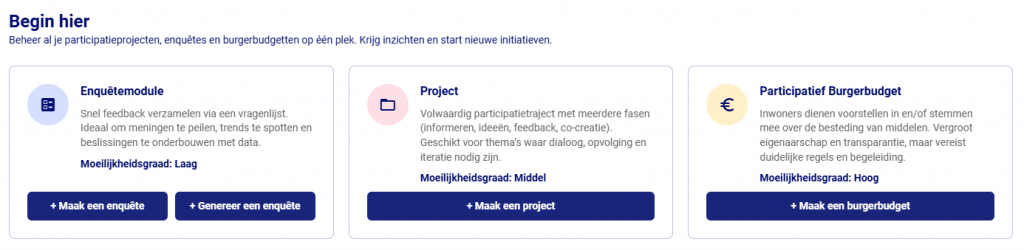
- A user-friendly survey module (now with branching logic!): Whether you need a quick poll or an in-depth study, you can create your questionnaire in no time. The intuitive editor makes it easy to generate or add different types of questions.
Want to explore a topic in depth without tiring out respondents? Branching logic automatically guides residents to specific follow-up questions based on their previous answers. The result is cleaner data and a better experience for residents.

- Optional role management: Managing multiple projects is now even easier. Optional role management lets you give back-office users access to specific projects or surveys without giving them access to other files. You can also assign different permissions: who can view, who can edit, and who has the final say on publication?
- Ready-to-use participation tools with a fresh look:
- Public and verified surveys
- Participation projects with multiple phases
- Simple ad hoc polls
- Forms for open calls and idea submissions
- Interactive maps
- Events calendar
- A public participation platform in your own branding
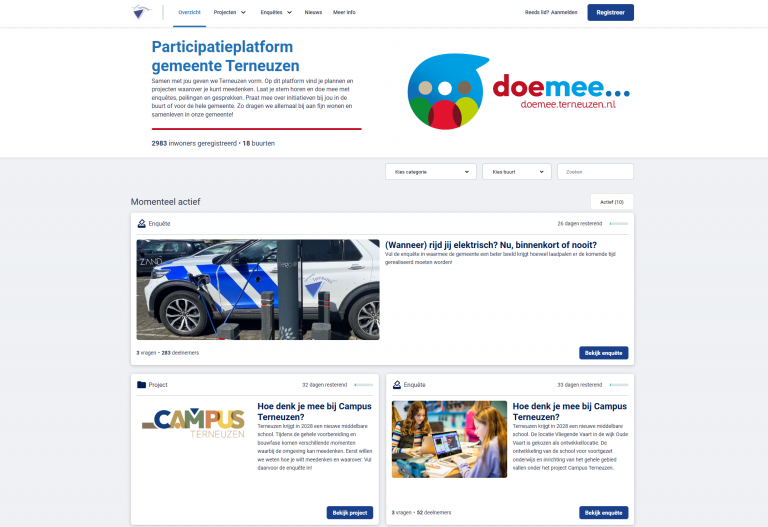
The public participation platform for local governments has also received a fresh look. Local governments can now present their participation projects more professionally and flexibly, with more configuration and layout options than ever before. Think clear project pages, well-organized information blocks, visual layouts by topic or phase, and public pages that better reflect the municipality’s branding and communication needs.
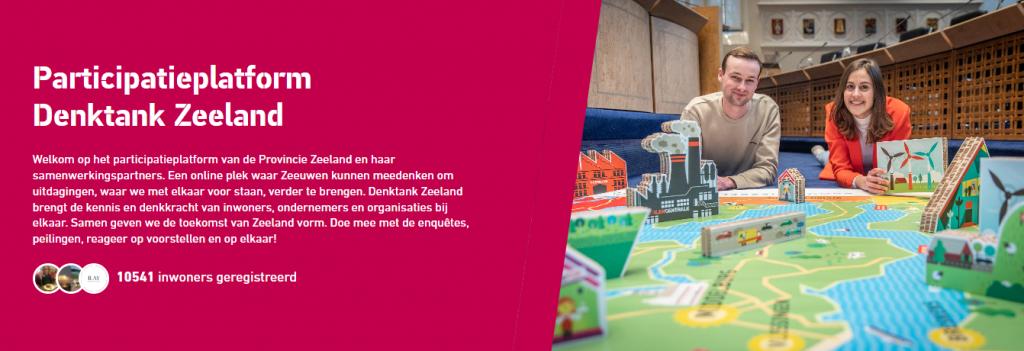
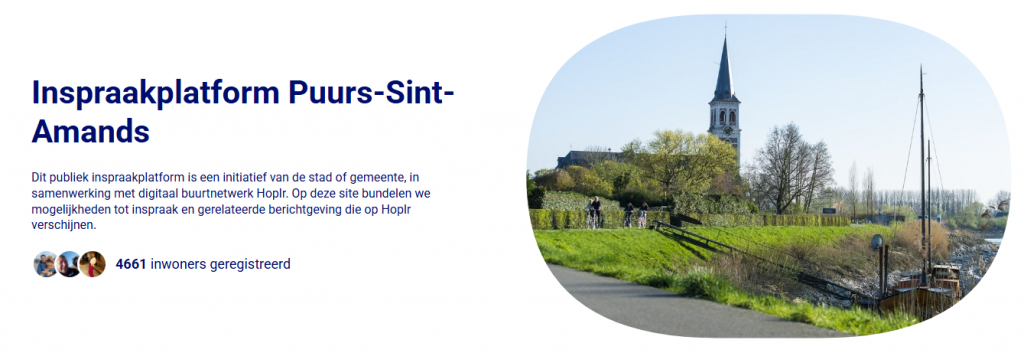
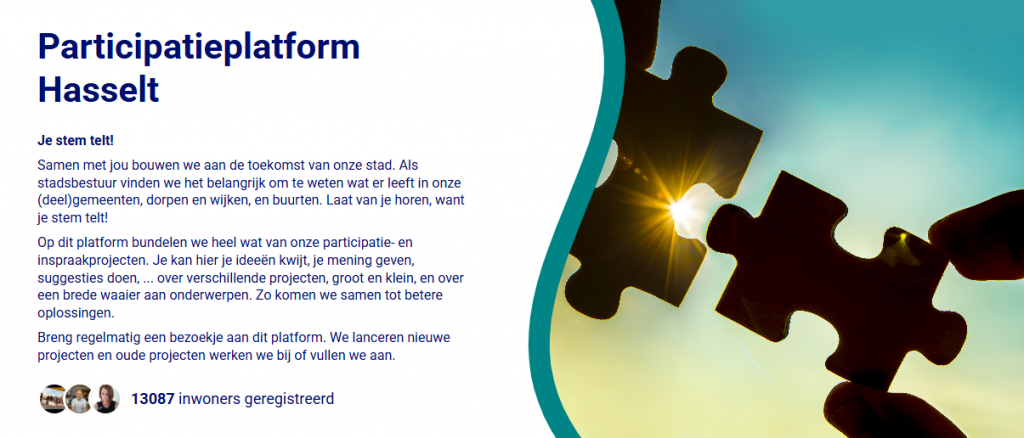
A few real-world examples from our clients:
- https://doemee.terneuzen.nl/
- https://denkmee.meise.be/
- https://szdenktmee.scherpenheuvel-zichem.be/
- https://inspraak.opwijk.be/
- https://www.idee-wo.be/
- https://participation.mons.be/
- https://participatie.diksmuide.be/
- https://www.denktankzeeland.nl/
- …
“Together with our communications team, we regularly use Hoplr to survey residents online. The process is remarkably smooth and efficient.”
Tim Van Gool, Puurs-Sint-Amands. Responsible for participation and policies for specific target groups
2. Reach residents through a channel they already use
Many participation tools start with the dashboard. Hoplr starts with the neighborhood.
A key difference from conventional project, participation, or issue-reporting apps is that Hoplr is not only used when there is a specific project, problem, or report. Hoplr is part of everyday neighborhood life. Neighbors use it to share information, ask for or offer help, share activities, exchange items, and keep up with what is happening around them. They can do this through the web version or the mobile app, bringing neighborhood information, municipal communication, and participation directly to residents’ fingertips.
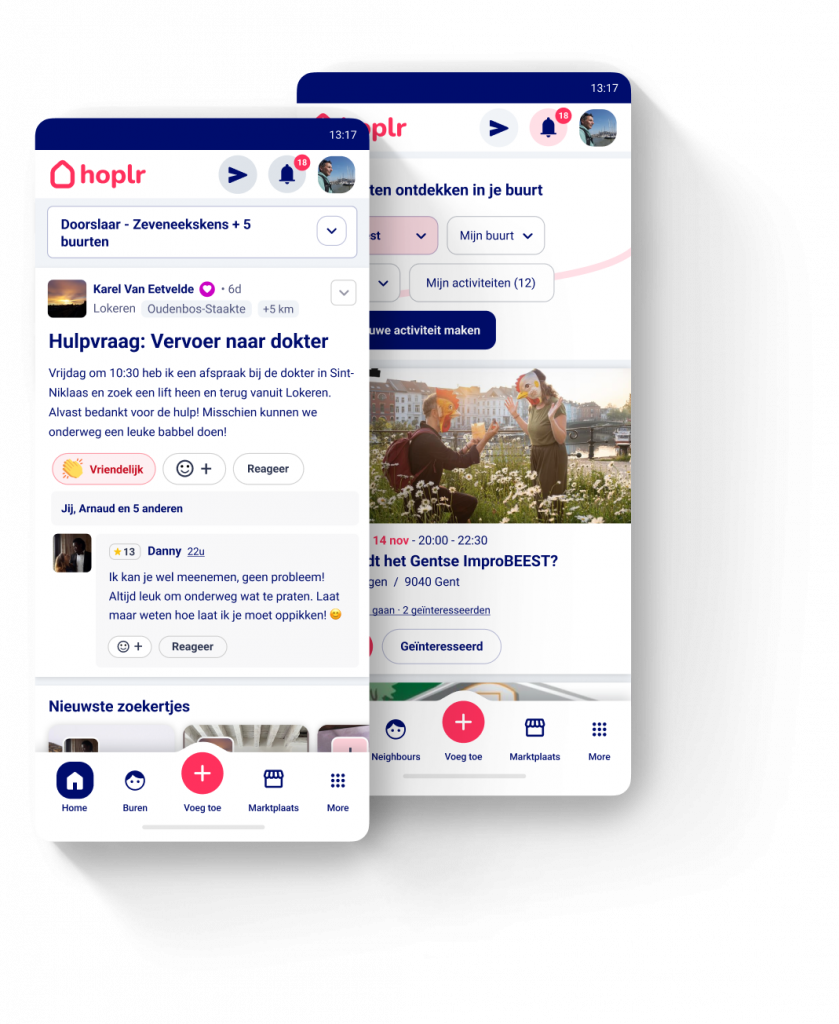
That daily or weekly use is precisely what makes the difference in many municipalities. When a local government, contractor, or project partner communicates about construction work, disruption, participation, or policy initiatives, it does so through a channel residents already know, trust, and use. Communication with the surrounding community becomes less dependent on one-off campaigns or project-specific apps, creating a lasting, recognizable communication channel between local government, residents, and local stakeholders.
This fundamental difference addresses one of the biggest challenges in public participation: reaching people.
- A built-in audience: You do not have to build an audience from scratch every time. Participation features are integrated into the Hoplr app, where an average of 32% of households are registered.
- Multichannel distribution: Every survey gets a unique URL that you can easily share through newsletters, websites, social media, or other communication channels.
- Targeted surveys with access codes: For representative samples or clearly defined target groups, you can use unique, single-use access codes.
“In 2012, 51% of young adults regularly chatted with their neighbors; by 2025, that figure had dropped to 25%. Technology makes it easy to stay indoors, and younger people, especially those who came of age during the pandemic, have fewer face-to-face interactions. The result is greater isolation and a growing dependence on algorithm-driven online communities.”
Source: https://www.axios.com/2026/05/13/americans-neighbors-socializing-less
“It is a new and original way for us to connect directly with residents, and for residents to connect with the city. Many channels already exist, and Hoplr complements them with its own features.”
Nicolas Martin, Mayor of Mons
3. From responses to targeted action with AI analysis
Participation does not end with collecting responses. The real challenge is interpreting the results. The Hoplr dashboard is designed to speed up this process.
- Real-time insights and AI-generated conclusions: As responses come in, our dashboard provides real-time statistics and sentiment analysis by neighborhood. The built-in AI assistant automatically generates summaries of the results, saving you hours of manual analysis.
- Professional reporting: Easily export your findings to Excel or PDF to share them with colleagues and policymakers.
- Direct support: You are never on your own. The Hoplr support team is ready to think things through with you and responds quickly to all your questions.
“Hoplr helped us carry out a thorough analysis of the neighborhood. By using the same questions as an urban planning study, we were able to compare neighborhood scores with citywide scores. This gave us a clear picture of the neighborhood’s strengths and weaknesses. Hoplr helped us organize the open-ended responses into a clear report, which we also shared with the city district.”
Wouter de Hoog, Community Builder, Municipality of The Hague
Why this approach is a better fit for many municipalities
A specialized platform can be useful for complex projects spanning several years. But in practice, many municipalities primarily need a solution that can be put to use quickly, makes it easier for residents to take part, and connects communication directly with participation.
By embedding public participation in a familiar neighborhood setting, a local government builds more than a participation process: it builds a lasting relationship with the community. Hoplr combines a simple back office, redesigned public participation pages, reach through the web and mobile app, and built-in analysis to move from input to action faster.
Above all: no hidden costs, no implementation headaches, just more impact with less effort.
“Where we live helps shape our lives. Neighborhoods rich in opportunity combine a mix of income levels, strong schools, and social capital, leading to better outcomes throughout life. Neighborhood conditions also affect health: social cohesion and access to services improve physical and mental well-being. Conversely, disconnection and isolation carry social and economic costs.”
Source: https://purposebuiltcommunities.org/2026/01/5-reasons-why-neighborhoods-matter-more-than-ever-in-2026/
Want to see how Hoplr can make your work easier?
Further reading
- How Puurs-Sint-Amands successfully involves residents in policymaking
A case study on clear communication, digital support, and participation as an ongoing dialogue. - The city of Mechelen reaches more than 16,000 households through Hoplr
An example of how a local government builds a strong digital neighborhood network over several years. - 3 simple actions that guarantee a broad reach on Hoplr
Practical tips to consistently increase reach and activity on Hoplr.
Our story and our mission
Hoplr is a fast-growing community engagement platform serving more than 250 local governments and 1 million residents. Since 2014, our mission has been to help local governments communicate and build connections through a unique social network for neighborhoods. We support local governments with neighborhood communication, community development, and public participation. Questions about our services? We are happy to help!
Contact services@hoplr.com
Neighborhood network: www.hoplr.com
Our services: services.hoplr.com
Frequently asked questions
How can a municipality make participation easier to organize?
Choose a suitable method, use a clear back office and share the project through channels residents already know. Allow time for follow-up and feedback.
Which participation formats does the article discuss?
It describes surveys, projects and participatory budgeting. The design can be adapted to the question, audience and desired level of detail.
What role can AI play in analyzing responses?
AI can help organize and summarize responses. Staff still need to check interpretations and account for the local context.
Does an existing neighborhood network guarantee a representative survey?
No. It can support recruitment, but organizers must examine who participates and add other channels where needed.
Share this article