Hoplr makes SROI visible: what does a neighborhood network really deliver?

“Social cohesion sounds great… but what does it actually bring in concrete terms?”
That’s a fair question that local governments are asking more and more often. Budgets are limited, and impact shouldn’t only be felt — it also needs to be explained, justified, and accounted for.
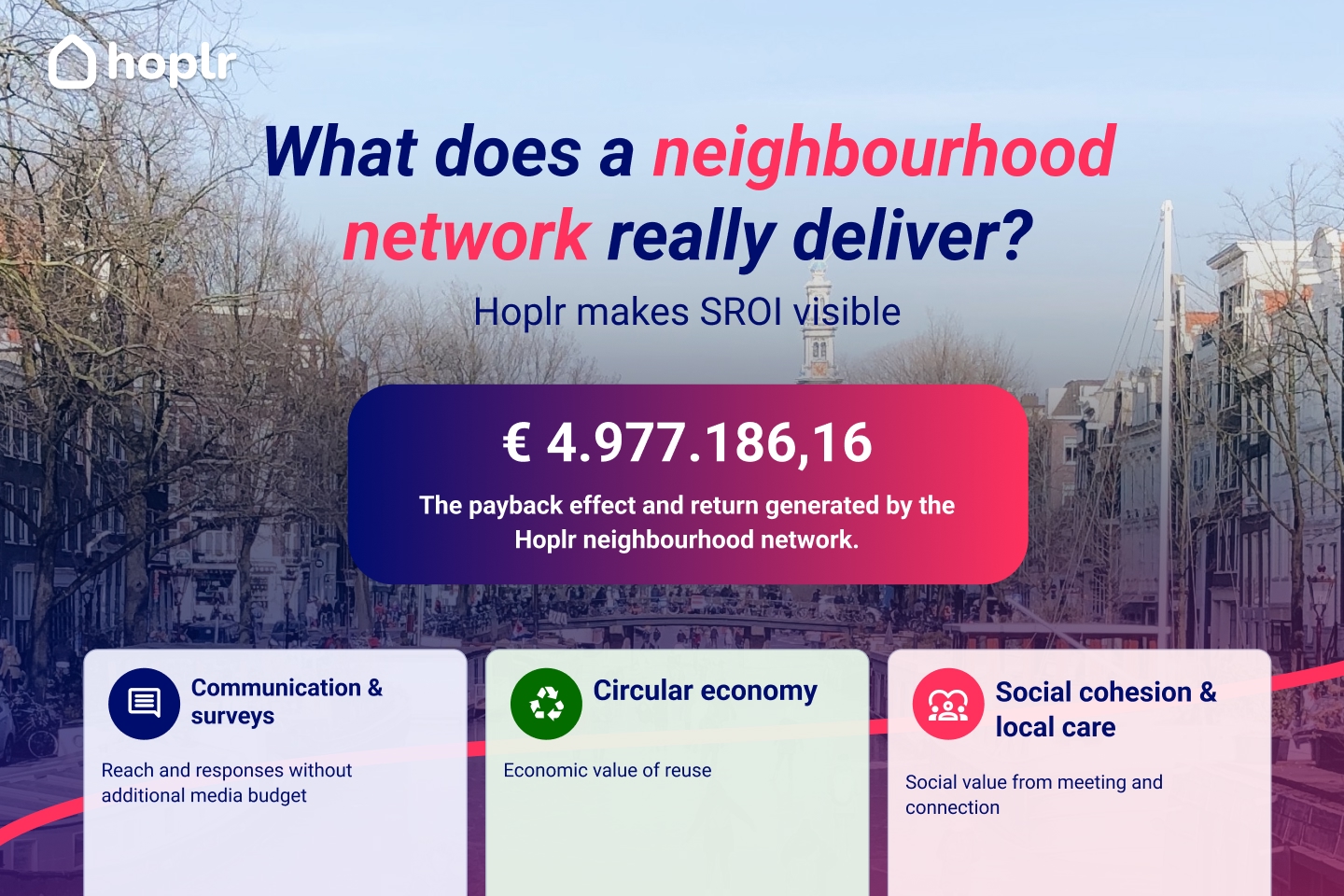
That’s why we’re adding a new section to our Impact Report 2025: SROI (Social Return on Investment). Or more simply: the payback effect and return generated by the Hoplr neighborhood network.
What is SROI (Social Return on Investment)?
SROI is a method for translating social impact into an economic equivalent. Not because “social” suddenly has to fit into euros, but because euros are often the language in which decisions are made.
In concrete terms, SROI bundles three types of value that Hoplr helps to create:
- Avoided costs through more efficient communication (reach and response without additional media budget)
- Economic value from reuse (items get a second life)
- Social value from meeting and connection (neighbor contact and neighbour-to-neighbour support)
Important: SROI is not revenue and not a traditional accounting return. It is a substantiated estimate based on platform data and reference values.
2025 at a glance: scale makes impact measurable
In 2025, we saw for example:
- +1.3 million households in +2,700 Hoplr neighbourhoods (average 32% adoption)
- +340,000 help requests, of which +156,000 resolved (≈ 46% resolution rate)
- +1 million neighborhood posts and +120,000 activities
- +200,000 offline meetings and +11 million online interactions
This activity is the “engine” behind SROI: without exchange, no impact; without impact, no payback effect.
What’s new: payback effect & return (SROI) in 2025
Based on reach, neighbour-to-neighbour exchange, average market prices and external references, we estimate the total economic and social value of the Hoplr neighborhood network in 2025 at:
€ 4,977,186.16
In addition, depending on local context and usage, we see that customers can achieve a return of 2x to 15x their annual licence cost.
How is this amount calculated? Three pillars:
1) Communication & surveys: reach and response without additional media budget
Hoplr is used by local governments as a reliable channel to inform, activate and consult residents. In SROI we translate this into an estimate of “avoided media costs”: what would this reach and response cost through traditional channels?
In 2025:
- 27,984,319 views on municipal communication
- 125,242 survey respondents
- Total media value: € 696,750.97
The calculation uses fixed reference values (such as an average CPM and a value per digital survey response).
2) Circular economy: economic value of reuse
Hoplr stimulates reuse: lending, giving away, reselling. That’s good for people’s wallets and reduces environmental impact.
In 2025:
- 143,005 items received a second life
- Total market value: € 3,038,856.25
- CO₂ equivalent: 4,190,047 kg (impact indicator)
Here we estimate value based on average second-hand value and replacement logic (fewer new purchases).
3) Social cohesion & community care: the value of meeting and connection
The hardest, but perhaps most important pillar: social cohesion.
That’s why we use an SROI approach that distinguishes between types of contact (one-off vs. stronger/sustained), and that builds on international references regarding the societal cost of loneliness.
In 2025:
- 180,562 one-off exchanges
- 24,249 stronger meetings
- Total social value: € 1,241,578.94
This distinction matters: not every interaction has the same impact. Neighbor support or sustained connections typically contribute more to wellbeing and resilience than a brief, one-off exchange.
Why this matters for local governments
SROI helps shift the conversation from “soft” to “strategic”:
- Communication: local reach without (extra) media budget
- Participation: response and engagement become more concrete and easier to justify
- Community building: meetings and neighbor support get a measurable place in evaluation
- Accountability: policy choices can be better substantiated towards management, finance and citizens
In short: Hoplr is not just a platform. It is infrastructure that enables local behavior — and that translates into tangible value.
Frequently asked questions
What does SROI mean in Hoplr’s impact report?
SROI translates estimated social effects into an economic value using platform activity and reference values.
Is the reported value money in a municipal budget?
No. It is an estimate, not revenue or a demonstrated budget saving that can be entered directly into accounts.
What is the estimate based on?
The article mentions communication reach, survey responses, reuse and encounters, combined with assumptions and external reference values.
Does the total amount apply to each municipality?
No. The report combines several Hoplr operations. A local estimate requires local data, suitable assumptions and a defined period.
Share this article