From pilot to success story: why Tulln chooses a city-wide rollout of Hoplr

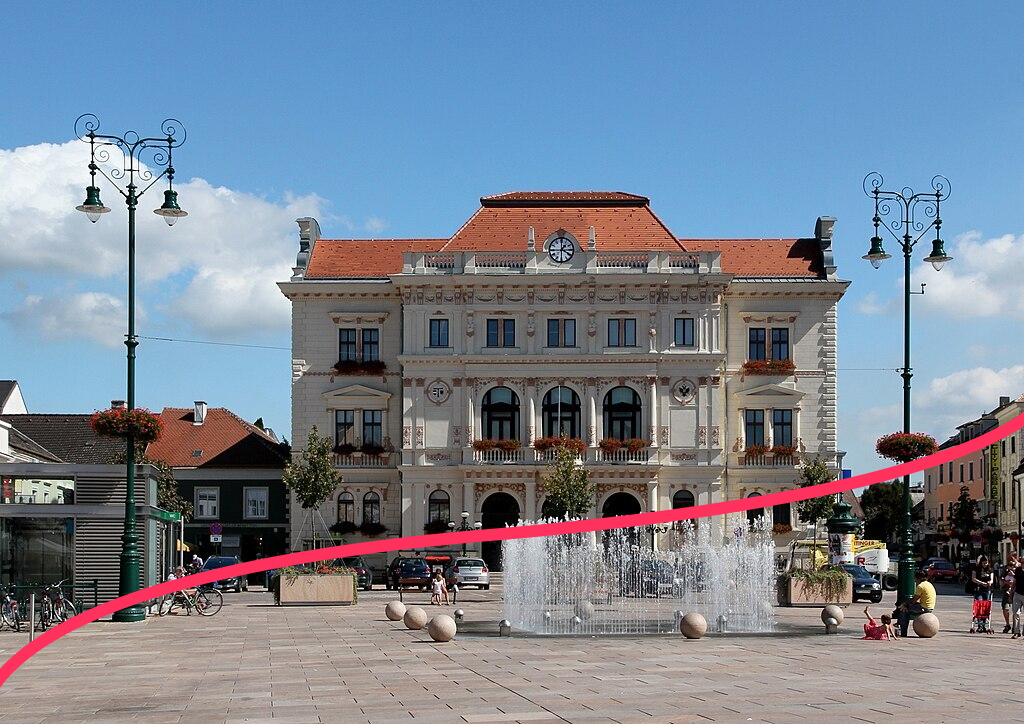
image: Tulln an der Donau, Hauptplatz © C.Stadler/Bwag
Community feeling is universal, but the way you facilitate it digitally requires a thoughtful approach. In the Austrian city of Tulln an der Donau, we recently proved that a small-scale pilot is the ideal starting point for a successful, city-wide rollout. The results demonstrate that Hoplr not only connects and activates but also scales seamlessly to an international context.
In this article, we take you through the journey of the municipality of Tulln an der Donau: from the pilot in one neighborhood to a massive city-wide adoption.
The perfect match: Stadt des Miteinanders
Tulln an der Donau is a historic municipality in Lower Austria with approximately 17,000 inhabitants. What makes Tulln, also known as the Gartenstadt (City of Gardens) due to its many parks and gardens, so special is not just its location on the Danube, but primarily its progressive vision on living together.
Under the banner “Stadt des Miteinanders” (City of Togetherness), the policy has been strongly focusing on local community building for years. They strive for an inclusive city where residents support, know, and work with each other.
“True community spirit is characterized by a climate of good neighbourly relations: Good neighbours complement and support each other. They look out for one another and therefore recognize when someone is going through a difficult time. Then they check in, listen, and see if they can do anything to help.”
Within the ambitious vision of “Stadt des Miteinanders,” Tulln has already experimented intensively in recent years with various digital channels, including Facebook, WhatsApp, and local initiatives such as FragNebenan. Although these platforms generated a certain reach, the municipality ran into structural limits that hindered further growth.
The experiences from previous pilots brought several clear bottlenecks to light:
- Fragmentation and bubbles: Interaction often remained limited to small, closed circles (“us-knows-us”) or conversely diluted into large, impersonal groups.
- Lack of depth: It proved difficult to conduct a meaningful dialogue via fleeting social media, both among residents themselves and between the citizen and the city administration.
- Commercial communication: Local platforms often became more of a local advertising channel, rather than a place where neighbors can consult each other, ask questions, and organize exchanges.
- Privacy concerns: There was growing resistance against ‘Big Tech’. Both the administration and the citizens were looking for an alternative to commercial, American platforms driven by data sales.
The choice for Hoplr was therefore a conscious strategic move to address these specific pain points. The municipality sought an independent, safe, and European alternative. A platform that transcends fragmentation by connecting neighbors geographically, and that offers an ad-free environment where trust in each other and in the local government is central.
“Hoplr has proven to be a very suitable tool that fills a gap: it is a secure and closed platform for our citizens. With it, we can foster community spirit and thereby achieve a steering effect for the benefit of the community.”
Mayor Peter Eisenschenk
The test: ease of use for the administration
For the municipality itself, it was crucial that the platform not only works to connect citizens but can also be deployed efficiently for the administration. During a two-month pilot, the communication service of Tulln an der Donau extensively tested the Hoplr dashboard and all functionalities.
The feedback from the administration was clear. The platform was perceived as user-friendly and straightforward to use. Additionally, the tools for targeted communication with specific neighbourhoods were labeled as very valuable, especially in a municipality that focuses on engaging its citizens.
“From a communications perspective, it is very helpful to be able to target information to specific neighbourhoods – for example, regarding local road closures – while simultaneously having the option to address everyone, for example, when announcing an event.”
Julia Schwanzer, Public Relations of the City of Tulln
The pilot confirmed that Hoplr can seamlessly integrate into the daily operations of a government service outside the Benelux, without heavy learning curves.
Phase 1: the pilot in one neighborhood
Technical tools are one thing, but do the residents embrace it? To test this, Hoplr was launched in one specific neighborhood in Tulln. Residents were invited via our proven invitation letter, and the response exceeded expectations.
“It was important to us to emphasize the feeling of community right from the app’s launch. Therefore, we decided to encourage all citizens to use the app with a personal letter from the mayor – with great success.”
Stefanie Jirgal, operational manager of the initiative “Stadt des Miteinanders”
The results of the pilot in figures:
- Registrations in the 2025 pilot: more than 300 households registered in Tulln Südwest. According to the pilot evaluation, this represented 22% of households in the pilot neighborhood, not the whole city.
- Contributions during the pilot: the evaluation reported that 60% of users contributed actively, for example through a post, comment, chat or event. This measures contributions within the pilot and is not a citywide reach figure.
The voice of the citizen: safety and connection first
The published pilot evaluation reports an average recommendation score of 8.4 out of 10. Respondents were asked whether they would recommend Hoplr to other districts of Tulln, on a scale from 0 to 10. In the chart in the original case study, a rounded 85% gave a score from 7 to 10. The final sample size, response counts for each question and fieldwork dates are not stated. These findings describe respondents, not all residents.
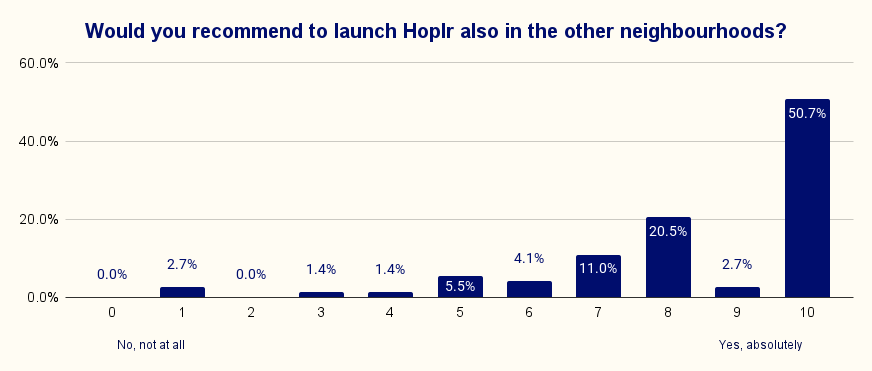
Residents embrace the platform not only for its ease of use but – as evidenced by the open feedback – explicitly view it as a ‘sensible European alternative’ to the large commercial players. This confirms that our core values regarding privacy and neighborhood orientation also align perfectly internationally with what citizens and local governments are looking for today.
“I find it enormously important that this app exists! People need a sensible, European alternative to Facebook and Instagram.“
Feedback from a resident of Tulln via the survey
In the published case study, 36% of pilot survey respondents said they had used Hoplr to contact neighbors they had not known before. This is a self-reported experience, not a count of all users or of offline meetings. One resident described the app in the survey as:
“A gift that makes Tulln an even more livable city”.
Feedback from a resident of Tulln via the survey
The responses provide insight into participants’ experiences. On their own, they do not prove that Hoplr increased social cohesion across the city.
Phase 2: scaling up to a city-wide success
Following the 2025 pilot, Tulln chose a citywide rollout in 2026. The following registration figures describe the first phase of that expansion, as reported in this case study:
- First phase of the citywide rollout in 2026: the case study reports more than 1,600 registered households in about two weeks, or 22% of households across Tulln. This covers a different geographic population from the pilot neighborhood.
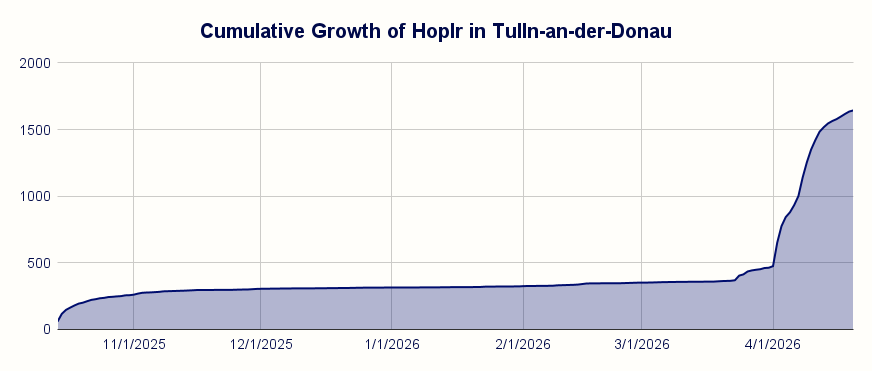
The city uses Hoplr to share information with individual neighborhoods or the whole municipality. Registrations, post views and unique readers are separate measures and require a defined measurement period.
A layered promotion strategy
The success in Tulln an der Donau is no coincidence, but the result of a well-thought-out communication strategy. To inform residents, the municipality utilized a broad mix of channels:
- Local anchoring: Publications in the city newspaper and articles on the official website.
- Press attention: Coverage in various local and regional newspapers.
- Visibility in the streets: The use of flyers and posters throughout the city.
- The personal ‘finishing touch’: Finally, every family in the municipality received a personal invitation letter in their mailbox. This physical letter remains a proven catalyst to guide residents from the mailbox to the digital neighborhood.
Hoplr: a proven and scalable model for every city or municipality
The Tulln an der Donau case demonstrates that a pilot is the ideal way to lay the foundations for a successful modernization of your citizen communication. This is true not only in Belgium, the Netherlands, or Luxembourg, but now also in Austria.
With a proven methodology and hard numbers supporting its efficiency, the step towards a safe and social neighborhood network is smaller than ever.
Frequently asked questions
Why did Tulln begin with a single-neighborhood pilot?
The municipality wanted to understand how residents and staff used the platform before deciding on a broader rollout.
What was evaluated during the pilot?
The case discusses registration, active use, return visits and the experiences of residents and municipal staff.
How did Tulln promote the citywide rollout?
The communication combined local press, visible promotion around the city and a personal invitation letter to households.
Can other cities expect identical results?
No. The approach can offer useful lessons, but outcomes depend on the local context and support for the rollout.
Share this article