Informal community care and longer independent living with Hoplr
Jennick Scheerlinck
·6 min read
It’s most seniors’ desire to live in their own homes for as long as possible. But living independently doesn’t mean ‘not needing help’. It means finding the help that allows them to keep on living in their familiar environment. Local governments are increasingly looking at the local community to provide the necessary informal care to allow just that.
Engaging the community to take care of its elderly members may be a challenge in today’s society. But especially for those without a personal support system and those who have trouble moving around, informal community care is likely the single most valuable and sustainable solution. To these people, the proximity of a caring neighbor is invaluable.
Hoplr supports local community building and citizen participation through dedicated software and a team of experts. Below, we share three ways in which we contribute to informal community care.
Launching the digital neighborhood network
For more social cohesion, citizen participation and informal community care (+2,000 neighbourhoods in Belgium, the Netherlands, and Luxembourg)
Launching our Neighborhood Concierge
(e.g. city of Aalst)
Conducting a neighborhood analysis
Carried out by our Knowledge Centre (e.g. Meise)
For each of these offers, we will below elaborate: What is it? How does it contribute to informal community care? How can you get started?
Launching the digital neighborhood network
What is it?
Hoplr connects local residents with each other and with their local government.
It is a social network that is only accessible to residents of the same neighborhood. Moreover, it is free of advertising. Neighbors receive an invitation letter and enter their digital neighborhood. 10 to 40% of households register during the first year.
The digital neighborhood network includes a dashboard for local governments. It provides tools for:
community care (find volunteers, connect community workers, etc.)
neighborhood communication (post messages, alerts, and activities in one, several or all connected neighbourhoods).
citizen participation (launch a survey, poll, citizen budget, public participation platform, etc.)
How does it contribute to informal community care?
Once registered, local residents can quickly call on the informal network of the neighborhood:
get to know each other;
ask for and share information;
exchange items (borrow, give away, share, …);
ask for and offer help;
develop ideas for the neighborhood; and
organize activities and place them in the neighborhood calendar.
Hoplr connects online in order to meet offline. Many people feel more comfortable asking a question online. Even those who are not digitally savvy can benefit from such a neighborhood network:
a caring, safe and resourceful community positively impacts the entire neighborhood, and thus all of its residents, even if they themselves are not members of Hoplr;
residents, informal caretakers and community workers form a bridge between Hoplr and those who do not have an account; and
the Neighborhood Concierge is an excellent addition, read more below.
Today, neighbourly help is one of the most important parts of our digital neighborhood network. We avoid labels such as ‘person in need of help’ and ‘help provider’. Everyone can help, and everyone needs help from time to time.
How (quickly) can you get started?
Book a demo about Hoplr here.
After reaching an agreement with the local government, we start with a kick-off meeting. In this meeting, we discuss the following matters:
Which neighbourhoods are we going to launch?
How will the invitation letters be distributed, and what will the letters look like?
What other actions will we take to get as many people registered as possible?
We have experience with over 120 local governments; you are in good hands. Count on two months from the kick-off meeting to rollout.
Launching our Neighborhood Concierge (BCQ)
What is it?
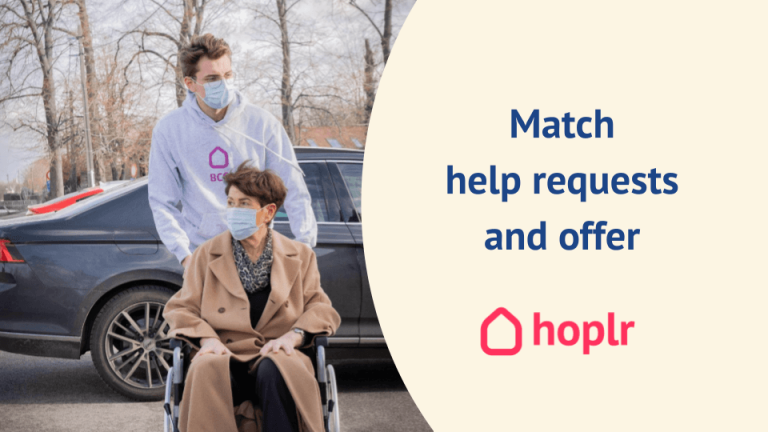
BCQ is an initiative of Hoplr to further simplify help exchange between community members. The Neighborhood Concierge serves as a bridge figure in the neighborhood. He or she builds a local network of local volunteers, neighbors, and professionals.
Subscribers place their help requests by telephone or via the app. The Neighborhood Concierge will immediately look for a verified volunteer or professional who can help. This way, even non-digital neighbors can always find reliable, local assitance. For example for:
Companionship
Grocery shopping
Transport
Chores around the house
Administration
…
Moreover, the Neighborhood Concierge monitors the well-being of subscribers by keeping in touch with them on a regular basis.
How does it contribute to informal community care?
On the one hand, BCQ significantly increases the well-being of senior citizens. With the help of the local support network, we aim to allow seniors to live independently at home for up to three years longer.
‹
›
But BCQ is for everyone. We actively develop an informal support network in the neighborhood: a database of local residents with talents, knowledge, and experience that can be useful to everyone.
How (quickly) can you get started?
Book a demo about BCQ here (mention BCQ).
BCQ has proved successful during a test phase in a few neighbourhoods. Now we are going to collaborate with a limited number of local governments to develop the project further.
The lead time depends very much on the approach: we can appoint a Neighborhood Concierge, or train an existing community worker to implement our method and software.
Performing a neighborhood analysis with our Neighborhood Scan
What is it?
Our experts have developed a method to carry out a neighborhood analysis called the ‘Neighborhood Scan’. We offer three formulas, including a collaborative neighborhood scan. This comprises the following:
Research administrative data
Standard Neighborhood Scan questionnaire
Representative sampling
Interviews
Workshops
Analysis
Report
We map out the strengths, challenges, opportunities, and needs of the neighborhood. Subsequently, we enter into dialogue with the local residents to formulate some action points.
You can find more information here.
How does it contribute to informal community care?
A neighborhood analysis is invaluable to understand where the needs of a neighborhood lie, as well as how they can best be addressed. Moreover, the results offer a baseline to measure the impact of your actions later on.
Workshop Neighborhood Scan in Meise
This neighborhood analysis in collaboration with local residents positively impacts community engagement, as well. It encourages community members to tackle challenges themselves, and ultimately to strengthen community feeling.
How (quickly) can you get started?
Book a demo of the Neighborhood Scan here (mention the Neighborhood Scan).
After reaching an agreement, we start a kick-off meeting in which we clearly define the expectations, target groups, division of tasks, and planning.
The latter depends very much on the chosen formula. Conducting our Neighborhood Scan usually takes two to four months.
Conclusion
Book an appointment with our team, and together we will explore how we can best stimulate informal community care. Request a demo here. Or, if you are looking for more inspiration, download our white paper on local community building below.
Frequently asked questions
Which approaches to caring neighborhoods does the article discuss?
It describes a digital neighborhood network, a Neighborhood Concierge and a Neighborhood Scan, each supporting a different part of local community work.
What does a Neighborhood Concierge add?
A recognizable contact person can discuss support needs and connect residents with suitable help, including people who find digital tools difficult to use.
When is a Neighborhood Scan useful?
It helps explore local needs, relationships and resources before choosing actions for the neighborhood.
Are the grants and launch timelines still current?
The article belongs to the 2022 context. Check current funding conditions, availability and planning before starting a new project.
Punt Welzijn, a service-oriented welfare organization in Weert and Nederweert, works to improve livability in the neighborhoods and encourage residents to make the most of themselves. They focus on various target…
A neighbourhood-oriented volunteering programme is more efficient, has more impact and also has positive side effects for the local community. In this article, we - as advocates of the neighbourhood -…