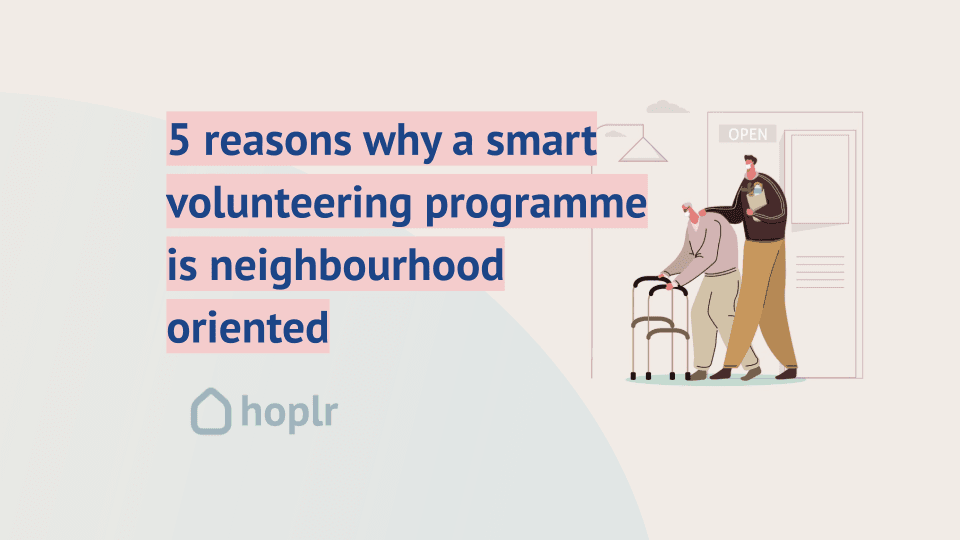
Volunteering: Five reasons why a smart volunteering programme is neighbourhood-oriented

Many residents are willing and able to help the vulnerable members of their community. Local governments and organizations offer support and structure in the form of volunteering programmes, making it easier for people to fall back on a support network.
A neighbourhood-oriented volunteering programme is more efficient, has more impact and also has positive side effects for the local community. We – as pro-neighbourhood advocates – share five reasons why the neighborhood level is the perfect breeding ground for volunteering.
#1 Proximity of local residents
If the person asking for help and the person providing the help live close to each other, the investment of time, energy and perhaps fuel is smaller. ‘Whether I can quickly pick up a package or an errand today? Why not, it's just around the corner.’
#2 High involvement
Engagement at the neighborhood level is higher than at the city or district level. If someone believes that they can make a difference in their immediate living environment, the willingness to help will be all the greater.
#3 Recognition and trust
Even when help requester and provider do not know each other by sight (although in this case, the chance is much greater), the shared context of the neighborhood offers some form of recognition. It is a small piece of shared identity that gives you the feeling of already knowing someone a little.
Neighbors also often share some reference points, such as people, places or events. These are good icebreakers and create an initial basis of trust.
#4 Tap into the neighborhood network
Every neighborhood has a wealth of social capital that can be used outside volunteer work. Think of information, talents, ideas, … But not everyone has access to this neighborhood network (to the same extent).
Sometimes one good link of an isolated person to the neighborhood network is enough to get (more) access. The volunteer can bring an isolated person in contact with another local resident, a local organization or the Hoplr neighborhood, based on their needs.
#5 Contribution to neighborhood feeling
Every positive exchange in the context of the neighborhood contributes to a positive neighborhood feeling. Not only for those directly involved but for all witnesses. It can be both fun and rewarding to publicly give kudos to volunteers within the neighborhood. A neighborhood where residents dedicate themselves to vulnerable members? Residents are certainly proud to be part of that.
Hoplr and volunteering
This article is the first part of a three-part series on volunteering. Soon, we will also publish a piece on counteracting hesitation to ask for help, as well as matchmaking between supply and demand. Keep an eye on our channels for the continuation!
Frequently asked questions
Why can neighborhood volunteering be practical?
Short distances can make small requests easier to fulfill. Neighbors also share a local context that offers a starting point for contact.
How can a volunteer connect someone with the wider community?
Alongside direct help, a volunteer can introduce other residents, local organizations or neighborhood activities.
Why does trust matter in neighborhood help?
Trust makes it easier to ask for and offer support. A shared neighborhood can help, but clear expectations remain necessary.
Why recognize volunteers locally?
Recognition makes their contribution visible and shows that helping others is valued within the community.
Share this article