Citizen participation: how physical encounters are key to more citizen engagement


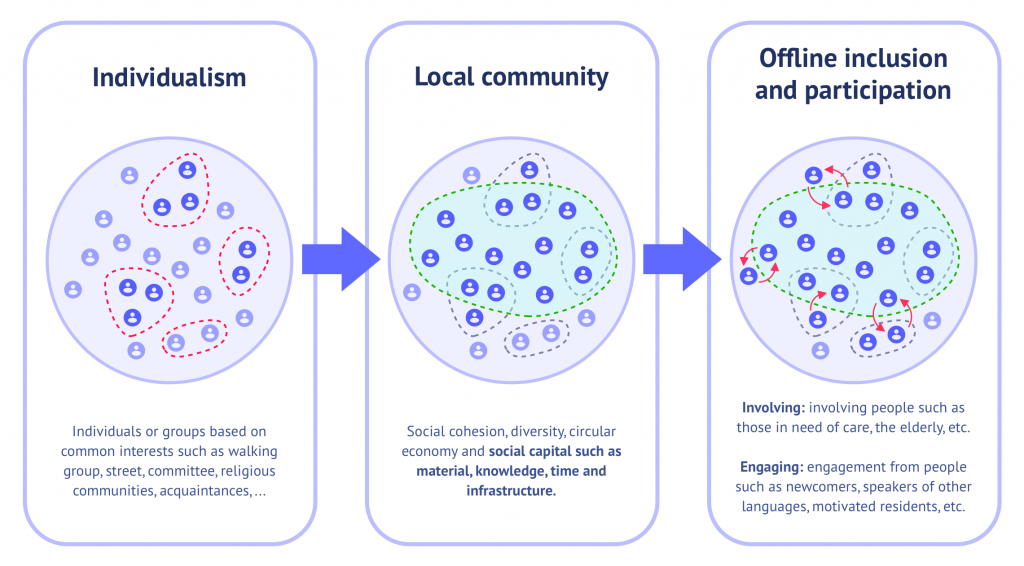
Neighborhood network Hoplr enables neighborhood communication and citizen participation. But in order to achieve successful and representative citizen participation, two non-digital ingredients are essential. A strong local community on the one hand and physical encounters on the other. In short: social cohesion.
Hoplr makes it easier for municipalities to stimulate both. In this article, we will discuss the importance of physical encounters. The question is two-fold. Firstly: what effect do physical encounters have on citizen participation? And secondly: how does Hoplr stimulate physical encounters?
What effect do physical encounters have on citizen participation?
We said the following about citizen participation many times before:
“Citizen participation is not an activity that you can just do from the comfort of your own home. It’s about conversation, collaborations and sometimes even getting your hands dirty. ”
But why is that? Well, face-to-face contacts offer some advantages in terms of citizen participation.
- sense of belonging
- involving the vulnerable
- involving doers
- stronger community
- participation mix
- sustainable initiatives
1. Sense of belonging
People who don’t feel like they have a place within a community are not often willing to make an effort. Consequently, they are not ready to participate. By encouraging physical encounters between neighbors, individuals feel more involved in their community and may also become more interested in policy and citizen participation.
Besides that, people don’t always show their best side when they can hide behind a computer screen. The more anonymous, the faster a discussion can get out of hand. When members of the community know each other ‘in real life’, online discussions take place in a more constructive manner.
We often hear that the same message on Hoplr triggers a more positive and constructive discussion than on Facebook. That’s probably because neighbors have a good chance of bumping into each other. For the same reason, offline moments ensure that participants take each other’s personal situations and opinions into account. This gives more room for compromises.
2. Involving the vulnerable
Foreign speakers, people living in poverty or persons with a disability,…: for some it is not so easy to take part in the conversation. Representative citizen participation, however, means that minorities and vulnerable people are also given the opportunity to make themselves be heard.
Many important organizations are committed to giving those vulnerable people a voice. For these (community) care givers, a meaningful long-term relationship with both the vulnerable person and their support system are essential, which also makes the importance of offline meetings indisputable.
Read all about how Hoplr can be of use to stimulate community care, here.
Besides, let’s not forget that not everyone has access to the online conversation. About 10% of Belgian inhabitants currently do not have internet.
3. Involving doers
Citizen participation does not only oblige us to take minorities into account, the silent majority should of course not be left out either. The less empowered citizen can feel intimidated when citizen participation takes a very verbal form, as policy topics and concepts can get difficult quickly.
They do not want to share elaborate opinions, but they may be eager to get their hands dirty. When citizen participation is action-oriented – think of a joint clean-up action – there is not only a direct, tangible impact on the surroundings, the less empowered citizen is also given the opportunity to contribute.
4. Stronger community
Of course, physical encounters between neighbors are not exclusively aimed at citizen participation. Hoplr’s mission is to bring neighbors closer together, so there can be less isolation and individualism. Neighborhood parties, garage sales, info sessions,… can all help to strengthen social cohesion in a neighborhood.
However, a strong local community with many physical encounters leads to more efficient citizen participation as well. A stronger community means a bigger audience for top-down surveys and participation projects on the one hand. On the other, it leads to fertile breeding ground for bottom-up citizens’ initiatives.
5. Citizen participation mix
people fill in sheets at a participation event
When a local government wants to here citizens’ opinions, the questioning methods naturally play a major role. Using of a multitude of tools guarantees the widest possible range of audience. If the government offers offline options to participate, the feedback will be much more representative.
In addition, offline citizen participation leads to co-creation. Citizens are not only invited to share their opinions and ideas. During offline participation moments, government and citizens can roll up their sleeves together.
6. Sustainable initiatives
Research shows that once citizens’ initiatives are launched, they are more likely to succeed if the participants have a lot of contact with each other and with the local community. In the physical world, initiators can often count on more volunteers and other stakeholders.
How does Hoplr stimulate physical encounters?
If physical encounters are so important for meaningful participation, why would a government need to invest in online tools? Well, physical encounters require a lot more effort and time from both citizens and government, than online communication does.
Not all citizens are willing to cut into their me-time or family time for an opportunity to participate. Neighborhood network Hoplr makes it easy for citizens to experience the neighborhood and to participate at their own pace. On the other hand, it is also much easier for the local government to survey a large group digitally and collect the results quickly.
The combination of both online and offline participation methods provide a reinforcing effect and the widest possible reach.
The road to representative citizen participation
The interaction between digital tools, physical encounters and social cohesion offers a set of participation methods that ensure maximum reach and involvement.
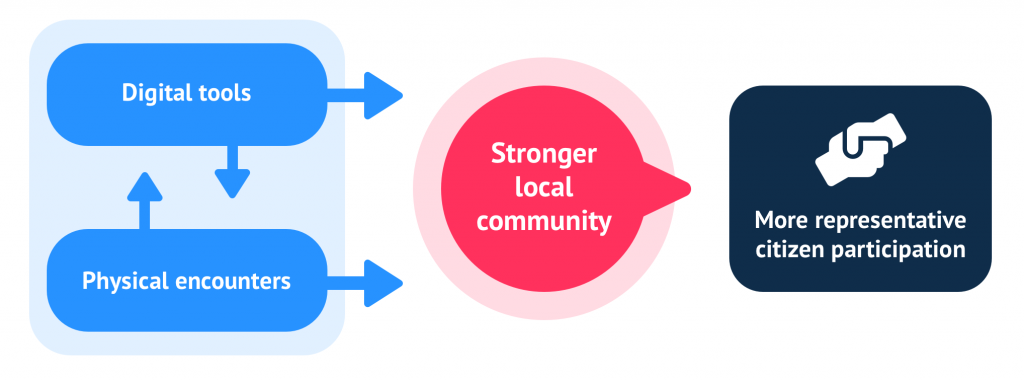
Hoplr stimulates physical encounters on two fronts: bottom-up and top-down.
Bottom-up encounters
Parallel to ‘bottom-up’ in terms of citizen participation, we can also think of physical encounters within the community as bottom-up. Citizens take the initiative to come together in all sorts of ways.
A digital platform makes it easier for people to set up these meetings. We don’t only view it as our responsibility to enable this, we want to actually stimulate neighbors to meet each other. Hoplr offers specific functionalities for physical encounters.
Neighborhood calendar
The concept of a ‘neighborhood calendar’ seems simple, but organizing it to encourage as many physical encounters as possible, requires some more thought. By default, a calendar gives you an overview of planned activities. This is how Hoplr was originally designed.
At the start of 2019, we took a different turn. Looking at our manifest, we believed that it was essential for our neighborhood calendar to:
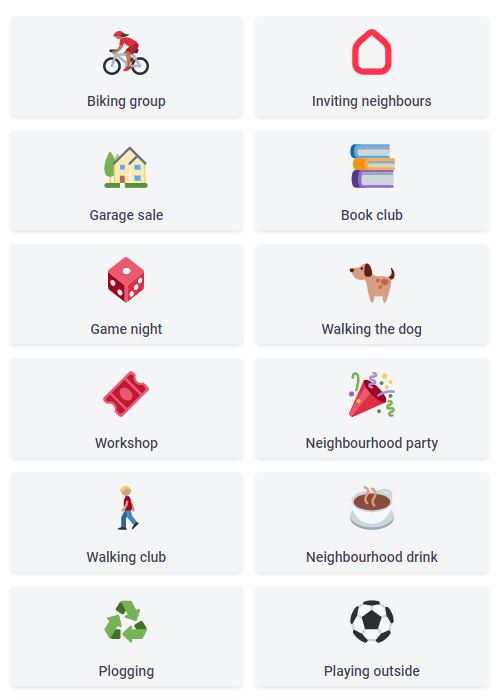
- inspire to come together in different ways;
- lower the threshold to take initiative;
- make it easier to set up an activity.
Activities for the neighborhood, by the neighborhood. Night life events and concerts had to make room for activities that were truly relevant to the local community: garage sales, clean-ups, neighborhood parties,…
By proposing specific themes when creating an event, we are not only able to limit the calendar to relevant neighborhood activities, we inspire the neighbors with fun ideas and encourage them to take initiative.
Also important: when creating a new activity, it’s possible to leave the date open. This way, neighbors can agree on a date that works for everyone. The person that creates the activity on Hoplr is not necessarily the one to organize it. Setting up an activity becomes a shared effort and the threshold for taking the initiative is lowered significantly.
Share requests for help and items
Planned activities are not the only reason for physical encounters. Neighbors can count on each other to exchange items and ask for help through the neighborhood platform.
When neighbors use Hoplr to find a ladder or babysitter within the local community – instead of, for example, their circle of friends – physical encounters naturally occur.
Results
Within the first two months of Hoplr’s new calendar’s existence, some 17,971 physical encounters between neighbors had taken place with the help of Hoplr. That is an average of 18 per neighborhood. 5,573 of these were planned events announced in the calendar. In addition, 9,774 requests for help and 2,624 exchanges of items were posted. Apart from that, users often tell us that they recognise neighbors because of Hoplr, which results in a friendly chat.
Top-down encounters
winners of the Hoplr-petanque tournament at Zuiderburen, an event for Antwerp neighbors, pose for the picture
In the case of a top-down meeting, the government takes the initiative to bring citizens together. A family event, a New Year’s reception or an opportunity to participate: municipalities can also use the neighborhood calendar, through the Service Dashboard.
Local governments can count on Hoplr, not only for its tools, but for support as well. For example, our team is happy to be present at events and info sessions.
a group of neighborhood leaders, team members and community workers from Ostend pose for the photo together
Conclusion
If you ask us, citizen participation starts and ends with the local community. Physical encounters and digital tools do not only enhance social cohesion, each in their own way. Ultimately, both will be necessary to actually realize meaningful participation.
That is why, as an online platform, we pay a lot of attention to physical encounter. This is the only way to bring government and citizens closer together (literally).
So, digital participation is certainly not an illusion, but without the involvement of the local community, it can miss its intended impact. And that would be a waste of the efforts and expectations of both citizens and local government.
Images: © Sebastiaan ter Burg / © Paul and Menno Ridderhof / © Hannes De Geest
Frequently asked questions
Why do in-person encounters matter for citizen participation?
Meeting neighbors can build trust and a sense of belonging. Those relationships can make it easier to discuss shared concerns and take action together.
How can a digital neighborhood network encourage offline contact?
Residents can announce activities, ask for practical help and exchange items. Each can create an opportunity to meet locally.
Why combine online and offline participation?
Different formats reach people with different preferences and levels of digital access. Combining them creates more ways to contribute.
Does a strong community guarantee representative participation?
No. Community ties can support engagement, but organizers still need to examine who participates and whose perspectives are missing.
Share this article